
Nothing is What We Think
It had never occurred to me that there was anything the human mind was incapable of understanding

Long before I was identified as “AuDHD” in middle age, my brain was given over a dozen different labels, and over the course of 20 years, I was placed on 19 different medications. I believed I was the identities I held: Smart. Fat. Writer. Mentally ill. Creative. Loser. Funny. I’d tell people my family had a genetic serotonin deficiency…and maybe we did. Or maybe we just thought too much.
“I think, therefore I am” was a revelation when Descartes first said it nearly 500 years ago, in 1637. As with all scientific and philosophical breakthroughs, though, we now know better. After all, psychiatrists no longer drill holes in the skull to allow demons to escape, and first responders don’t blow tobacco smoke into the rectums of humans who have drowned—both practices popular around the time of Descartes.
The intellect, which processes thoughts, can be helpful at times, but it’s not the be-all and end-all of human existence.
Thoughts may be real, but they’re not true
This is a line from meditation teacher and psychologist Tara Brach. It means that just because thoughts exist in our heads (they are real to us), that doesn’t make them true. Even those that seem true from our limited perspective aren’t necessarily true from other perspectives, much less any kind of ‘absolute’ perspective.
The only absolute is that love/source/goodness is true, and anything else—fear, hatred, lies—is false. And even that may not be true. I don’t know. Perhaps the biggest challenge we face is that every single human believes that they’re right.
How we interpret our experience depends on conditioning
As a child, I dreamed lucidly and seemed to travel between dimensions at night; I implicitly understood that there were other ‘me’s around the world, and at times, I believed I could see particles of energy (though they also might have been dust particles). I would scream and cry if my parents didn’t play Mozart (and only Mozart) when I went to bed, and I was obsessed with the idea that every choice I made would alter my future. Should I lift my left foot first, or my right?
I was raised in a home where only the intellect was recognized and valued. Emotions were dismissed, and self-reflection was actively punished. I soon lost the experience of direct connection, the awareness of being embodied, and I was left only with my beliefs about being human.
In my 20s, I read Pema Chodron, Jon Kabat-Zinn and others, but I was only able to take in their words at an intellectual level. Someone suggested I read The Power of Now in 1997, and I dismissed the idea (and Eckhart Tolle) because he’d been recommended by Oprah and therefore, I didn’t believe he couldn’t be a serious teacher (I was that much of an intellectual snob. Sigh.)
Our thoughts can make us abdicate responsibility
Instead of looking at how my experiences had filtered my perception of the world, and learning to compassionately question my thoughts, I turned my whole life over to Western medicine and took virtually no responsibility for my own emotional well-being. I was still interested in the idea of nonduality, but I chalked the anxiety and depression up to genetics and destiny.
I spent a cumulative 20+ years in psychodynamic (talk) therapy, starting in my teens. In all those years, I became an expert in articulating the stories of my life. Stories are interpretations, not facts; they’re articulations of a belief, designed to help people make sense of what might otherwise seem to be chaos. As screenwriting guru Robert McKee says, “Stories are the currency of human contact.” Except… at a deeper level, that’s not the currency.
When awakening broke through in 2010, the stories and trauma energy disappeared instantly. [The energy came back in 2019, but that’s another post.] I realized that my beliefs were irrelevant. What happened had nothing to do with thoughts; My mind couldn’t even grasp what had happened. In 44 years, it had never occurred to me that there was anything the human mind was incapable of understanding.
We see through our own filters
“We see the world not as it is, but as we are.”
—Anaïs Nin
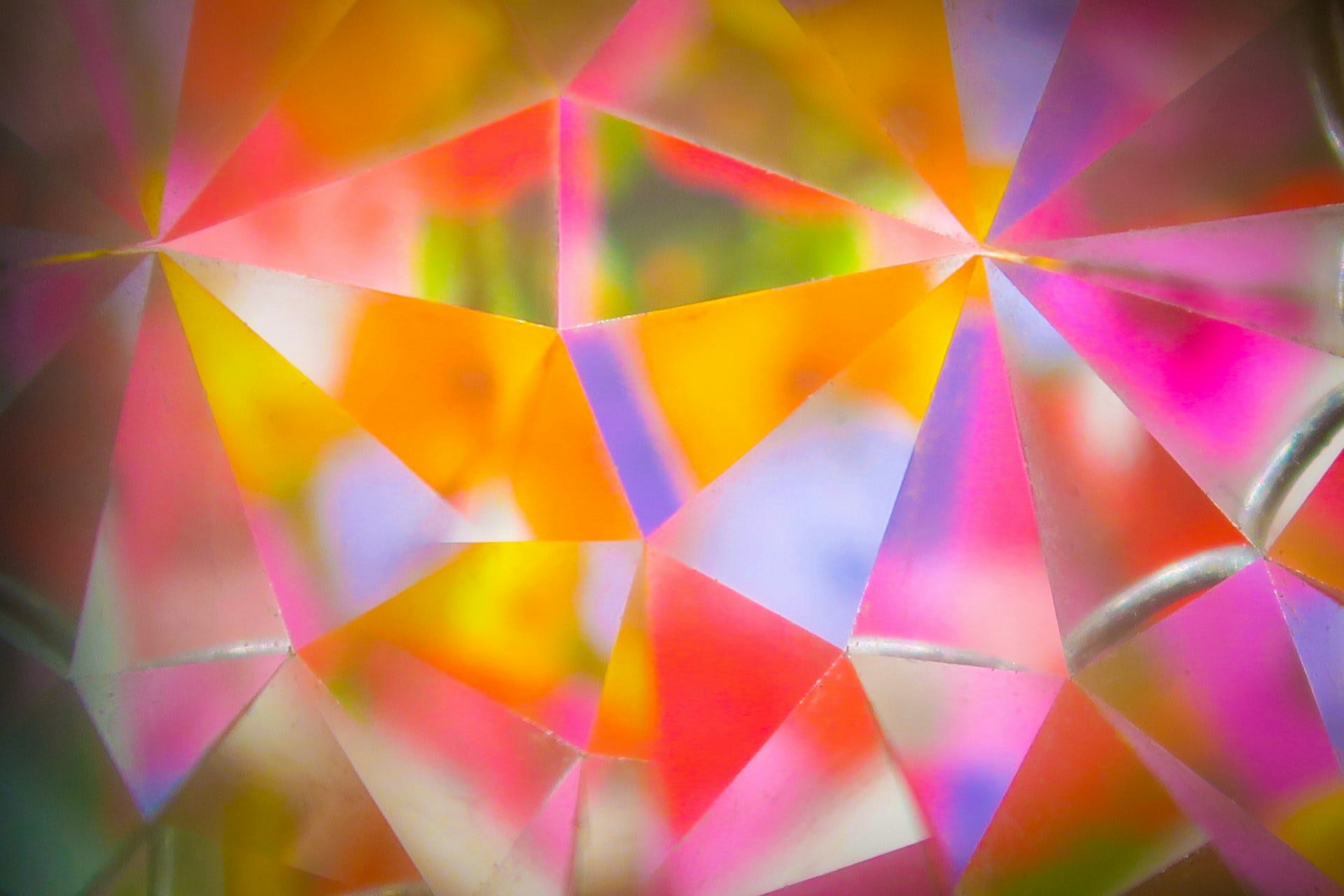
Each of us sees the world through filters created by our conditioning: family, cultural, religious, educational, organizational and more. That’s why I chose the image at the top of this post: What we see is mostly filters, through which there’s sometimes a shrouded sense of ‘reality’.
For example, we might perceive a coworker standing by our desk, saying words. Yet how we perceive those words (and our colleague) has very little to do with the actual content of their words, or the actual coworker; we hear what we expect to hear, given all our conditioning and how much we’ve projected our disowned traits onto the coworker.
Basically, life is one big game of Telephone. There might be one sound in the phrase that makes it around the circle, but 90% of the message has been distorted.
Developmental delay? Spiritual gift? It depends on the lens
Take the word ‘autism.’ A label like ‘developmental delay’ seems factual, but it’s actually a collection of assumptions (thoughts) wrapped in clinical language. That’s necessary in a culture where healthcare is for-profit. In order for systems to run economically, people need to be sorted and categorized. That doesn’t make those labels—or what they imply—true.
It might not even be a pathology, except in the context of a culture that rejects interdependence and insists on standardized ‘milestones’. In other words (gah!), these labels don’t exist for the benefit of the individual; they exist to hold together capitalism and patriarchy.
My colleague Lisa Cooper Ellison, in one of her awesome Writing Your Resilience newsletters, mentioned The Telepathy Tapes. It’s a podcast series, soon to be a documentary film, about spiritual gifts of non-speaking children on the autism spectrum. They might appear developmentally delayed, but on the more important level, the spiritual one, they seem to be far more advanced than other humans.
In addition, autism probably isn’t one thing, just as “neurotypicality” isn’t. There’s a famous saying that “if you’ve met one autistic person, you’ve met ONE autistic person.” It’s not just a spectrum; it’s a constellation of potential traits, which seems to make it… just another way of being human?
Language, beliefs and conceptual constructs are inherently symbolic; they are not the same as whatever they point to. The word ‘dog’ is not the same as the experience of having a furry companion curled up at your side.
We think we understand the world around us, and then one day, we get a potentially scary health evaluation, or the systems we believed in so deeply begin to crumble. Those can be scary moments, for sure. Yet they also begin to point us to the truth: that our thoughts aren’t what we think
One more thing…
Thank you for reading this Counterintuitive Guide post. I understand you’re probably swamped with emails, and I appreciate that you took the time to read this. If you found this post helpful, here are some simple ways to support this Substack:
Subscribe to this Substack, if you don’t already
Upgrade to a paid subscription (bonus: you’ll be supporting a Canadian 🇨🇦!)
Click or tap the heart ❤️ icon to like this post. I appreciate every one of those!
Leave a comment about what spoke to you the most about this post.
Share this post by ‘restacking’ (use the ‘quote’ function to say what helped you the most about this post)
Forward this email to a friend or share the link on social media
In a very nice, well-written way, you just blew me away with this piece, my dear friend. Sometimes I feel like I'm still just at the beginning of understanding myself after 62 years. ☺️
This is amazing. Working to write memoir, these ideas deeply resonate with me. I dig deep into my past and find layers of telephone passages, spectrums of experience, and lots of discomfort telling my truth that will be different from others who were there. Thanks coach....this is great! Debbie